
The Internet Is Being Re-Invented... Again!
Web1 gave us static pages and dial-up wonder. Web2 gave us social networks, streaming, and the app economy - and handed extraordinary power to a small number of platform companies that monetized our data, attention, and trust.
Web3 is the next chapter. It is not simply a new set of technologies — it is a fundamental reimagining of who owns the internet, who benefits from it, and who gets to set the rules. Powered by blockchain, decentralized protocols, smart contracts, and token-based incentives, Web3 promises to shift the internet’s center of gravity from corporations to individuals.
Whether you are a developer, an entrepreneur, a creator, or simply someone who uses the internet every day, the Web3 transition will affect you. This article explores what Web3 actually is, how it differs from what came before, and what the future of the internet looks like as this paradigm takes hold.
To understand where the internet is going, it helps to understand where it has been. Each generation of the web has been defined not just by its technology, but by its relationship between users, creators, and platforms.
• Web1 - The Read-Only Web (1991–2004):
Systematically comparing creative variants to identify what resonates.
• Web2 - The Read-Write Web (2004–Present):
Web2 brought us interactivity, social media, user-generated content, and cloud computing. It democratized content creation but concentrated economic power in the hands of platform intermediaries. Google, Meta, Amazon, and Apple became the custodians of our digital lives - and our data became their most valuable asset. The user became the product.
• Web3 - The Read-Write-Own Web (Emerging):
Web3 introduces a third dimension: ownership. Built on blockchain infrastructure, Web3 enables users to own their data, their digital assets, and a stake in the platforms they use. Value flows to participants, not just shareholders. Intermediaries are replaced by code. Trust is enforced by mathematics, not by corporate terms of service.
Web3 is not a single product or platform — it is an architectural shift built on several interlocking technologies. Understanding these building blocks is essential to understanding the future they are creating.
Blockchain:
At the foundation of Web3 is the blockchain: a distributed ledger maintained by a decentralized network of computers rather than a single company. Blockchains record transactions in a way that is transparent, tamper-resistant, and not controlled by any single entity. Ethereum, Solana, Polkadot, and Avalanche are among the most prominent blockchain platforms underpinning Web3 applications.
Smart Contracts:
Smart contracts are self-executing programmers stored on a blockchain that automatically enforce the terms of an agreement when predefined conditions are met. They eliminate the need for intermediaries in everything from financial transactions to voting systems to supply chain management. The code is the contract — and it runs exactly as written, without the possibility of interference.
Decentralized Applications (dApps):
Built on top of smart contracts, decentralized applications (dApps) function like traditional apps but run on peer-to-peer networks rather than centralized servers. They cannot be taken down by a single company, censored by a government, or arbitrarily modified by their creators. Users interact with dApps directly through their own wallets, retaining control of their data and assets.
Tokens and Digital Ownership:
Tokens - both fungible cryptocurrencies and non-fungible tokens (NFTs) - are the native economic primitives of Web3. They enable programmable, verifiable ownership of digital assets and create new mechanisms for aligning the incentives of users, developers, and investors. Token-based governance allows communities to collectively make decisions about the platforms they use.
Web3 is more than a technical upgrade - it is a value system. Several core principles define the vision that its builders are working toward.
Decentralization:
No single entity controls the network, the data, or the rules. Decentralization distributes power across participants, making systems more resilient to censorship, single points of failure, and corporate capture. In a truly decentralized web, a platform cannot unilaterally ban a user, change the rules mid-game, or sell user data to the highest bidder.
User Sovereignty and Data Ownership:
In Web3, your data belongs to you. Rather than storing personal information on corporate servers, users hold their own cryptographic keys and manage their own digital identities through self-sovereign identity systems. You decide what to share, with whom, and on what terms — without a company acting as an intermediary or profiting from your personal information.
Permissionless Innovation:
Open, composable protocols allow developers to build on top of existing Web3 infrastructure without seeking permission from any gatekeeper. This “money LEGO” or “open composability” approach dramatically accelerates innovation, as protocols can be freely combined and extended in ways their original creators never anticipated.
Native Digital Economies:
Web3 enables entirely new economic models. Creators can monetize their work directly, without platform intermediaries taking the majority of the revenue. Communities can pool resources and coordinate through Decentralized Autonomous Organizations (DAOs). Digital goods can be owned, traded, and ported across applications in ways that are impossible in the walled gardens of Web2.
Web3 is not theoretical. Across multiple sectors, decentralized applications are already redefining how people interact with money, media, art, governance, and the broader digital economy.
Decentralized Finance (DeFi):
DeFi protocols enable lending, borrowing, trading, and earning yield on digital assets — all without banks, brokers, or financial institutions as intermediaries. Users interact directly with smart contracts, accessing financial services that are available to anyone with an internet connection, regardless of their geography, credit score, or institutional access.
Digital Ownership and NFTs:
Non-fungible tokens have introduced verifiable digital scarcity and ownership to the internet for the first time. Beyond speculative art markets, NFTs are being applied to event ticketing, gaming assets, music royalties, domain names, and personal identity — any context in which provable ownership of a unique digital item creates meaningful value.
Decentralized Social Media:
Emerging protocols like Farcaster, Lens, and Bluesky’s AT Protocol are building social networks where users own their social graph, their content, and their audience — not the platform. If a platform built on these protocols changes its policies, users can simply migrate to another client without losing their followers or their history.
DAOs and Collective Governance:
Decentralized Autonomous Organizations allow communities to pool capital, make collective decisions, and coordinate action through smart contracts and token-based voting systems. DAOs are being used to manage investment funds, govern open-source protocols, coordinate creative projects, and even acquire cultural artefacts. They represent an entirely new model of human organization.
The Decentralized Metaverse:
Virtual worlds built on Web3 infrastructure — such as Decentral and The Sandbox — allow users to own virtual land, create experiences, and build economies that are not controlled by a single company. Unlike corporate metaverse platforms, decentralized virtual worlds are governed by their communities and cannot be shut down or monetized without user consent.
Web3 is a compelling vision, but it is important to engage with it critically. The path from today’s early infrastructure to a widely adopted, user-friendly decentralized internet is long, and significant challenges remain.
• Scalability:
Many blockchain networks still struggle to process transactions at the speed and cost required for mainstream adoption. Layer 2 solutions and next-generation consensus mechanisms are addressing this, but it remains an active area of development.
• User experience:
Managing private keys, understanding gas fees, and navigating wallet interfaces is intimidating for mainstream users. The Web3 ecosystem must achieve the seamlessness of Web2 before broad adoption is realistic.
• Regulatory uncertainty:
Governments worldwide are still developing frameworks for digital assets, DeFi, and decentralized governance. Regulatory clarity will be essential for institutional adoption and long-term ecosystem stability.
• Environmental concerns:
Proof-of-work blockchains have historically consumed significant energy. The industry’s shift toward proof-of-stake and other energy-efficient consensus mechanisms is addressing this, but the perception challenge remains.
• Centralization pressures:
There is a persistent irony in Web3: many of the most widely used tools and infrastructure providers are themselves highly centralized. True decentralization requires ongoing vigilance and intentional design choices at every layer of the stack.
These are not fatal objections - they are engineering and governance problems that the Web3 community is actively working to solve. But they serve as a reminder that the gap between the vision and the reality requires sustained effort to close.
The Web3 transition will not happen overnight, and for most people it will feel gradual — more like the adoption of smartphones than the flipping of a switch. But its implications for how value is created, captured, and distributed online are profound.
For Businesses:
• New monetization models:
Tokenization enables businesses to create native digital economies around their products, rewarding early adopters and loyal customers with ownership stakes rather than just loyalty points.
• Programmable trust:
Smart contracts reduce the need for expensive legal and administrative infrastructure in commercial relationships, enabling faster, cheaper, and more transparent transactions.
• Community-owned growth:
Token-based incentive structures allow businesses to align the interests of users, contributors, and investors in ways that traditional equity structures cannot.
For Creators:
• Direct monetization:
Web3 enables creators to sell directly to their audiences without platform intermediaries capturing the majority of the revenue. Smart contracts can also enforce royalty payments automatically on secondary sales.
• Ownership of audience:
Decentralized social protocols ensure that a creator’s audience relationship cannot be taken away by a platform’s policy change or algorithm shift.
For Everyday Users:
• Data sovereignty:
Your personal data, browsing history, and digital identity belong to you - and you decide how they are used.
• Financial inclusion:
DeFi opens access to financial services for the estimated 1.4 billion adults worldwide who remain unbanked or underbanked.
• Participation in value creation:
Rather than being a product of the platforms you use, Web3 enables you to be a co-owner, earning a share of the value your participation creates.
These are not fatal objections - they are engineering and governance problems that the Web3 community is actively working to solve. But they serve as a reminder that the gap between the vision and the reality requires sustained effort to close.
Web3 represents the most significant architectural shift in the internet’s history since the introduction of the World Wide Web itself. It is a shift from an internet owned by corporations to one owned by its participants - from a digital economy that extracts value from users to one that distributes it among them.
The infrastructure is being built right now. The protocols are being written. The applications are being launched, tested, and refined. The transition will be uneven, contested, and at times chaotic - but the direction is clear.
The question is not whether Web3 will reshape the internet. It is whether you will be ready when it does.
Note: This article is intended for informational and educational purposes. The Web3 landscape is evolving rapidly; readers are encouraged to conduct their own research and consult qualified professionals before making technology or investment decisions.
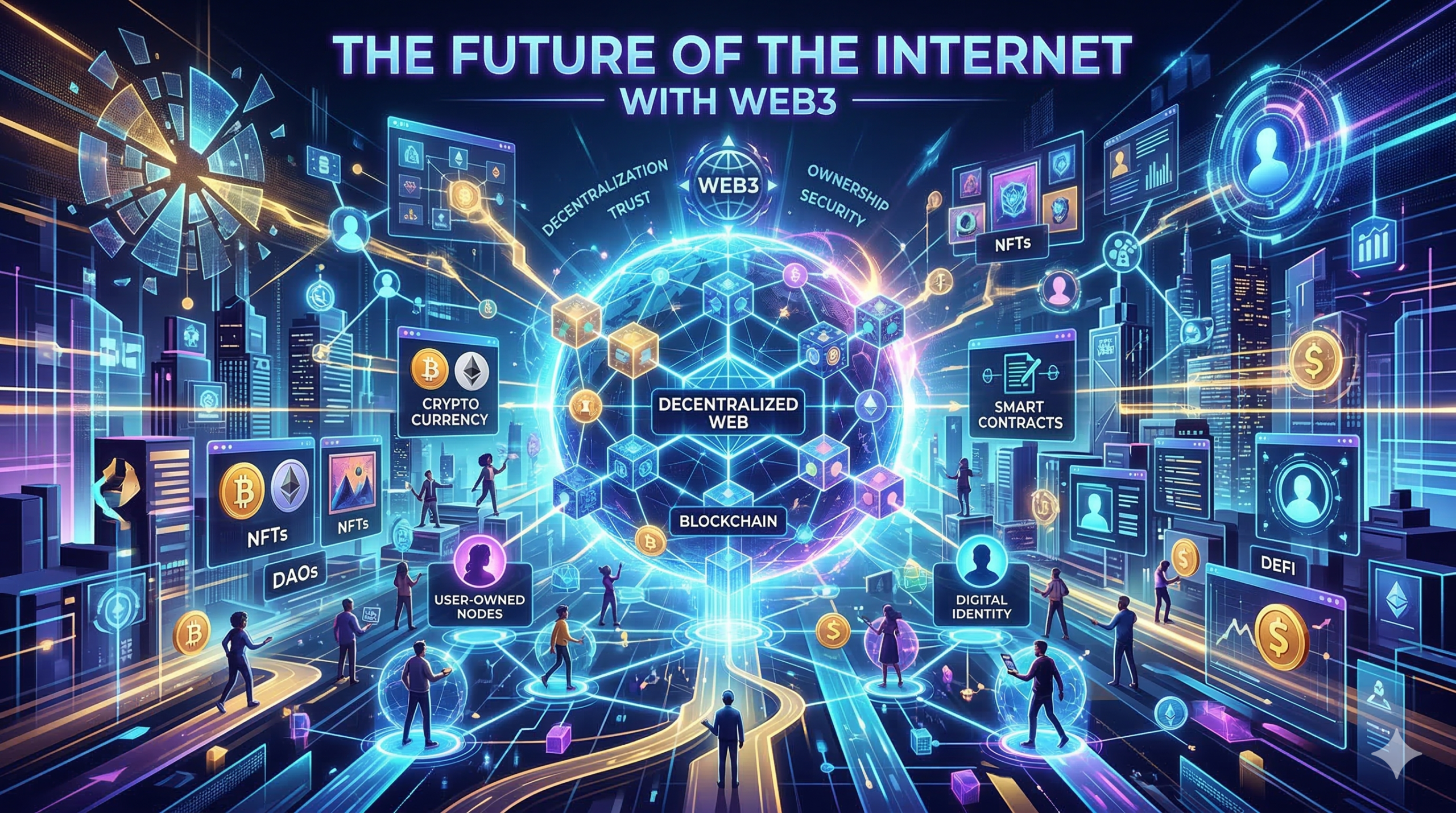
The featured image at the top of this article was generated by Ai using Google Gemini.